
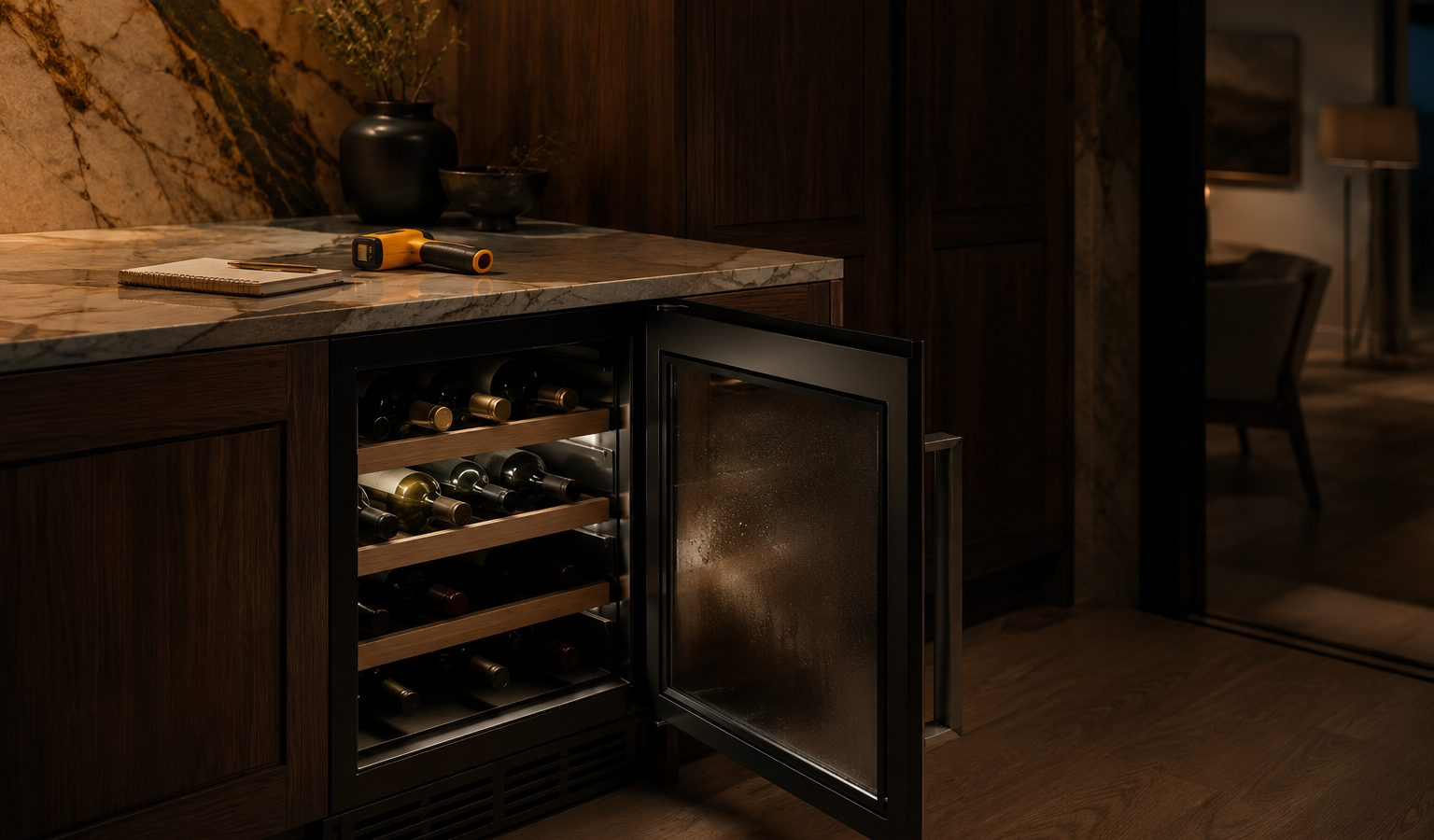
U-Line Outdoor Refrigerator Not Cooling in Hot Weather
Outdoor refrigeration works in a tougher environment than an indoor unit. High ambient temperature, direct sun, restricted front ventilation, a poor door seal, heavy loading, sensors, fans, controls, or the…

An outdoor U-Line refrigerator that struggles in hot weather is often reacting to its surroundings: high ambient temperature, direct sun, a restricted front grille, or heavy door traffic. Check those first, because a unit pushed past its rated conditions can behave like a failed one and a real fault looks different once the environment is corrected.
Outdoor refrigeration works in a tougher environment than an indoor unit. High ambient temperature, direct sun, restricted front ventilation, a poor door seal, heavy loading, sensors, fans, controls, or the refrigeration system can all affect cooling.
Start With the Operating Pattern
- Measure actual cabinet temperature and note outdoor conditions.
- Keep the front ventilation path clear.
- Check door closure and reduce unnecessary door openings during the test.
Change one condition at a time. Resetting power, changing settings, cleaning several systems, and moving the unit all at once can erase useful evidence.
| Symptom | What it can point to | What you can safely check |
|---|---|---|
| Warm only during the hottest part of the day | Ambient above the rated range, direct sun, or heat nearby | Shade the area if possible and note when it warms |
| Warm all day, grille cluttered or dirty | Restricted front airflow or a dirty condenser | Clear the grille and keep the area around it open |
| Warm after many door openings | Normal recovery after heat enters the cabinet | Reduce openings and track recovery over several hours |
| Warm with frost or wet gasket | Door not sealing or humid air entering | Inspect the gasket along every edge |
U-Line-Specific Context
U-Line products use compact, front-vented and undercounter-oriented refrigeration architecture. Exact model, installation type, water/drain configuration, and controller generation matter before technical information is applied. Ice machines add water level, drain, cleaning, refrigeration, pump/auger/harvest, and sensor stages that should be evaluated in sequence.
Why the Symptom Is Not the Diagnosis
A symptom identifies a system to investigate; it does not identify one replacement part. Installation ventilation, water/drain conditions, door or drawer sealing, sensors, fans, pumps, controls, compressor operation, and the sealed refrigeration system can create overlapping symptoms.
Why does the rated temperature range matter outdoors?
The outdoor-designed drawer unit’s guide for one model gives an operating ambient range of 50F to 100F and says to keep the unit out of direct sunlight. The clear-ice guide for another model notes that higher ambient temperatures can reduce the ability to reach low temperatures. Check your own manual for the range that applies, since it varies by model.
The refrigerator guide for one model adds that the cabinet temperature depends on the set point, ambient temperature, sunlight or heat sources, door openings and how long the door stays open, the interior light, and anything blocking the grille or condenser. In a hot yard several of those stack up at once.
When the Pattern Needs Professional Diagnosis
If the unit cannot recover under normal rated conditions, model-aware diagnosis should separate installation and ambient effects from internal cooling-system faults.
Is every U-Line unit meant for outdoor use?
No. Not every U-Line unit is made for outdoor use, and a unit must be designed for it for outdoor operation to apply.
Not every U-Line unit is meant for outdoor use. A nugget-ice guide says warranty applies to outdoor operation only for units designed for it by model and serial number, and an indoor guide limits those units to interior applications. If yours was not designed for outdoors, no amount of shading changes that, and the model label is the place to confirm it.
The outdoor drawer guide also says restricted airflow inside the cabinet can cause poor performance, uneven temperatures, and even frozen contents, so leave space between bottles and the internal vents. Reduce loading before a heat wave and test again before concluding the unit has failed.
What to Record Before Service
Write down the complete U-Line model number, product family, indoor/outdoor and panel-ready status, exact symptom, measured temperature where relevant, ice-production stage where relevant, water/drain behavior, and any E-code, Er-code, flashing LED, cleaning reminder, door message, or communication warning before reset.
Good observations reduce repeated owner checks and let the technician choose a focused test path. A cabinet that is warm after a large load, an ice machine that fills but does not harvest, and an ice machine that never receives water are three different diagnostic starting points.
Error-Code and Platform Context
Installation and Access Context
Leave undercounter, panel-ready, drawer, or outdoor U-Line products installed unless the service team specifically requests access. Moving a unit can disturb cabinetry, flooring, front-ventilation clearances, water lines, drains, or electrical connections.
For condos, high-rises, outdoor kitchens, and custom bars, include loading, elevator, shutoff, drainage, and clearance details when booking.
Common Mistakes to Avoid
Do not clear a useful code before recording it. Do not use a commercial-controller meaning for a residential appliance because the letters look the same. Do not treat a cleaning reminder or steady-status light as a hardware fault.
One controlled owner-level check is useful when it answers a question. Repeated resets, disassembly, or aggressive cleaning can remove evidence or create a second problem.
Hot Weather Questions
Can an outdoor refrigerator be too hot to cool properly?
Yes. One model’s guide gives a rated ambient range, and above it the unit may not reach low temperatures. Shade, ventilation, and lighter loading can help before you assume a fault.
Should I move an outdoor refrigerator into the shade?
Keeping it out of direct sunlight matches one model’s guidance. Moving a built-in unit can disturb clearances and connections, so ask before relocating it.
How do I tell a heat problem from a failed part?
If cooling returns when the sun and heat load are removed, the environment was likely the cause. If it stays warm in normal conditions, book diagnosis.
Related U-Line Reading
- For adjacent symptoms, read U-Line Refrigerator Not Cooling: Separate Ventilation, Door Sealing, and the Cooling System and U-Line Beverage Center Not Cooling: Check Airflow, Loading, and Temperature Recovery.
Similar Articles
- U-Line Wine Refrigerator Not Cooling: One Zone, Both Zones, or the Whole Cabinet?
- U-Line Refrigerator Not Cooling: Separate Ventilation, Door Sealing, and the Cooling System
- U-Line Beverage Center Not Cooling: Check Airflow, Loading, and Temperature Recovery
- U-Line Wine Refrigerator Not Cooling: One Zone, Both Zones, or the Whole Cabinet?

Turn this guide into a clear on-site diagnosis
FAQ
Frequently asked questions
Use one normal model-approved restart when appropriate and record any code or message first. If the symptom returns, repeated resets are not a repair.
No. The technical source preserves model and control-platform applicability because the same raw code can differ by generation.
Do not perform live electrical, internal pump/control, or sealed-refrigeration work. Leave tightly fitted units installed unless safe access is planned.
U-Line has multiple residential generations, ice-machine architectures, dual-zone products, and separate commercial controllers. Exact model identity prevents the wrong diagnostic path.
Keep reading
More from the guides
U-Line Wine Cooler Fan Running Constantly: When Long Runtime Is a Clue
A fan can run for long periods during normal recovery, but constant fan operation combined with unstable temperature, frost, unusual noise, or a warm cabinet may indicate an…
U-Line Drawer Refrigerator Not Cooling Properly
A refrigerated drawer can warm because the drawer is not sealing, airflow is blocked, the front ventilation path is restricted, the temperature sensor is seeing an abnormal condition,…
U-Line Wine Refrigerator Not Cooling: One Zone, Both Zones, or the Whole Cabinet?
A U-Line wine refrigerator should be evaluated as a temperature trend. On dual-zone products, whether one zone or both zones drift helps separate zone sensing and airflow from…
Turn this guide into a clear on-site diagnosis
Book a repair
Tell us what’s wrong — we’ll take it from there
Share a few details and we’ll confirm an appointment. Prefer to talk? Call us and we’ll help right away.
Phone
(844) 706-1091
Hours
Mon–Sat: 8:00 AM – 7:00 PM
Service area
Serving Miami, New York, Houston, Los Angeles and San Diego metro areas.
Response time
Response time varies by location and service availability.
Request your repair
Fill in the form below and we’ll confirm an appointment.