
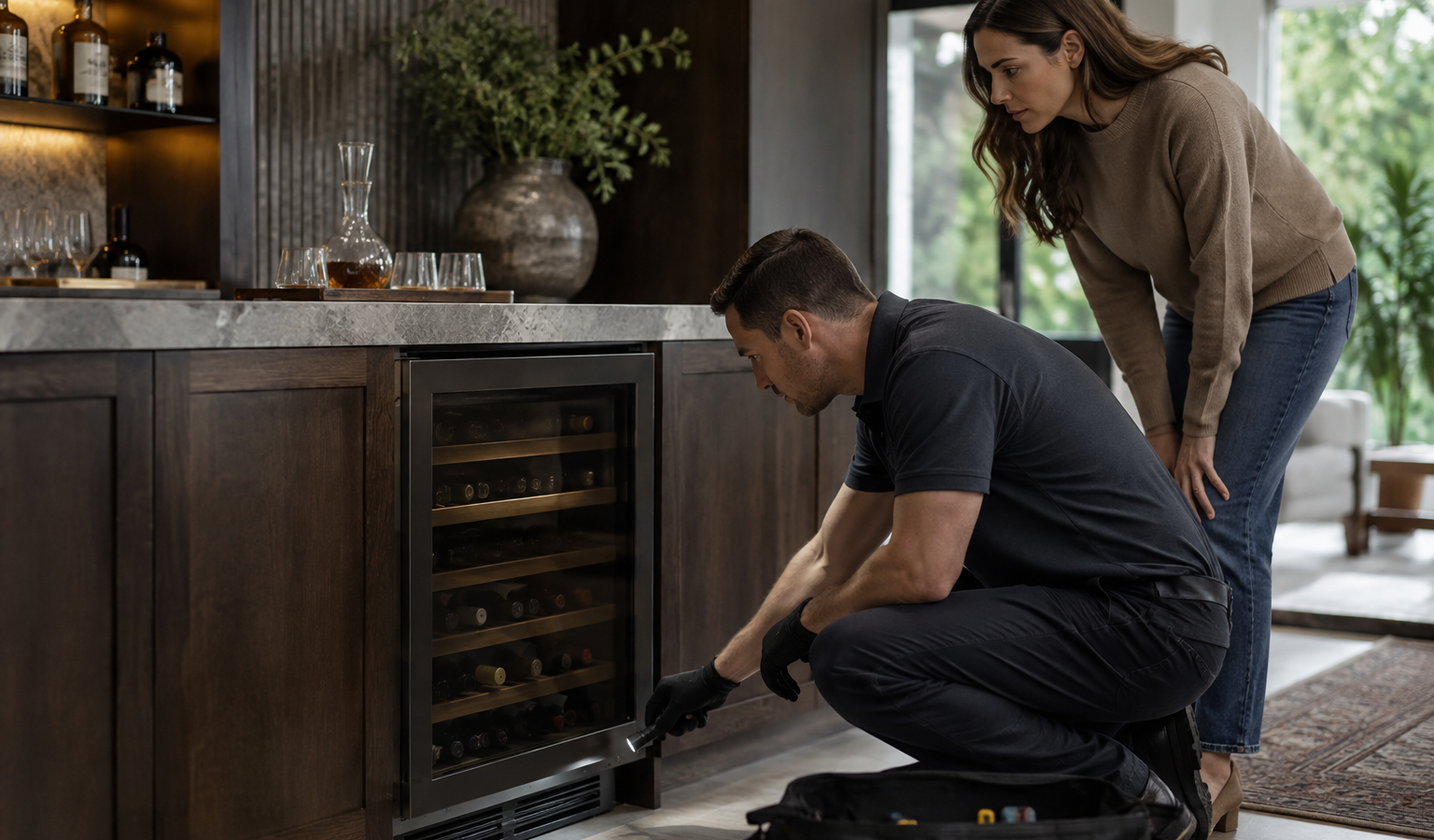
U-Line Wine Refrigerator Not Cooling: One Zone, Both Zones, or the Whole Cabinet?
A U-Line wine refrigerator should be evaluated as a temperature trend. On dual-zone products, whether one zone or both zones drift helps separate zone sensing and airflow from a shared refrigeration or control problem.

When a U-Line wine refrigerator is not cooling, the first useful question is whether one zone or the whole cabinet is drifting. One zone off points toward that zone’s sensing or airflow, while both zones warm points toward something shared such as ventilation or the cooling system.
A U-Line wine refrigerator should be evaluated as a temperature trend. On dual-zone products, whether one zone or both zones drift helps separate zone sensing and airflow from a shared refrigeration or control problem.
Start With the Operating Pattern
- Measure each zone independently where the model has separate zones.
- Check bottle loading and door closure.
- Keep installation ventilation clear and note room temperature.
Change one condition at a time. Resetting power, changing settings, cleaning several systems, and moving the unit all at once can erase useful evidence.
| Symptom | What it can point to | What you can safely check |
|---|---|---|
| One zone warm, the other fine | Zone sensing, airflow to that zone, or loading against vents | Check bottles are clear of the vents and the zone setting is correct |
| Both zones warm | Blocked grille, dirty condenser, or a shared cooling fault | Clear the grille and compare against room temperature |
| Zone cooling in short cycles | A zone sensor fault leaving the unit on a fixed cycle | Report the pattern and any displayed code |
| Display shows a door message | Door open too long or not sealing | Close the door fully and check the gasket |
U-Line-Specific Context
U-Line products use compact, front-vented and undercounter-oriented refrigeration architecture. Exact model, installation type, water/drain configuration, and controller generation matter before technical information is applied. Ice machines add water level, drain, cleaning, refrigeration, pump/auger/harvest, and sensor stages that should be evaluated in sequence.
Why the Symptom Is Not the Diagnosis
A symptom identifies a system to investigate; it does not identify one replacement part. Installation ventilation, water/drain conditions, door or drawer sealing, sensors, fans, pumps, controls, compressor operation, and the sealed refrigeration system can create overlapping symptoms.
How does a dual-zone wine refrigerator sense each zone?
The service guide for one U-Line dual-zone wine model describes separate thermistors for each zone, separate evaporator thermistors that drive defrost, and an ambient thermistor near the condenser used for diagnostics. If a zone thermistor fails, it describes the unit continuing to cool on a fixed cycle: for the 2000 series, ten minutes on and forty minutes off. A failed evaporator thermistor falls back to a preset defrost timer, while a failed ambient thermistor lets the unit run normally.
That means a zone that is wrong while the compressor runs can be a sensing fault and not a lack of cooling. Check your manual for which behavior your model uses.
A displayed temperature that differs from the set point is not a fault by itself. One guide says it means the unit is still moving toward the target, and how long that takes depends on ambient conditions, how much product is inside, and how often the door is opened. If a zone is still far off after a full day with the door left alone, that is the point at which the pattern deserves a service look.
Door state also matters on these cabinets. The dual-zone guide logs a separate error for the upper and lower door being open and shows only the door error with an audible tone, so a door message can sit alongside a cooling complaint. Close both doors fully and check that bottles are not holding either one ajar.
When the Pattern Needs Professional Diagnosis
If one zone or the whole cabinet cannot recover, fans, thermistors, controls, or the refrigeration system may need model-specific diagnosis.
How do you set zones and load wine?
The same guide says to set the top zone first, switch to the bottom zone, and confirm. A 3000-series guide gives each zone its own mode and set point, such as red wine, white wine, or sparkling, through one control module. Setting a zone to the wrong mode can look like poor cooling.
U-Line’s storage guidance runs about 60F for red, 50 to 55F for white, and about 45F for sparkling, and a Wine Captain unit needs 24 hours to stabilize after stocking. Judge cooling over a day, not minutes after loading.
What to Record Before Service
Write down the complete U-Line model number, product family, indoor/outdoor and panel-ready status, exact symptom, measured temperature where relevant, ice-production stage where relevant, water/drain behavior, and any E-code, Er-code, flashing LED, cleaning reminder, door message, or communication warning before reset.
Good observations reduce repeated owner checks and let the technician choose a focused test path. A cabinet that is warm after a large load, an ice machine that fills but does not harvest, and an ice machine that never receives water are three different diagnostic starting points.
Error-Code and Platform Context
Installation and Access Context
Leave undercounter, panel-ready, drawer, or outdoor U-Line products installed unless the service team specifically requests access. Moving a unit can disturb cabinetry, flooring, front-ventilation clearances, water lines, drains, or electrical connections.
For condos, high-rises, outdoor kitchens, and custom bars, include loading, elevator, shutoff, drainage, and clearance details when booking.
Common Mistakes to Avoid
Do not clear a useful code before recording it. Do not use a commercial-controller meaning for a residential appliance because the letters look the same. Do not treat a cleaning reminder or steady-status light as a hardware fault.
One controlled owner-level check is useful when it answers a question. Repeated resets, disassembly, or aggressive cleaning can remove evidence or create a second problem.
Wine Refrigerator Cooling Questions
Why is only one zone warm?
It can be loading, zone setting, or that zone’s sensing or airflow. A shared fault would normally affect both.
How long should a wine refrigerator take to settle after stocking?
One model’s guide says to allow 24 hours for product temperatures to stabilize. Do not change settings repeatedly during that time.
Does a warm zone mean the compressor failed?
Not necessarily. Sensing, airflow, and settings can all produce a warm zone, so confirm with a measured temperature before assuming that.
Related U-Line Reading
- For adjacent symptoms, read U-Line Refrigerator Not Cooling: Separate Ventilation, Door Sealing, and the Cooling System and U-Line Beverage Center Not Cooling: Check Airflow, Loading, and Temperature Recovery.
Similar Articles

Turn this guide into a clear on-site diagnosis
FAQ
Frequently asked questions
Use one normal model-approved restart when appropriate and record any code or message first. If the symptom returns, repeated resets are not a repair.
No. The technical source preserves model and control-platform applicability because the same raw code can differ by generation.
Do not perform live electrical, internal pump/control, or sealed-refrigeration work. Leave tightly fitted units installed unless safe access is planned.
U-Line has multiple residential generations, ice-machine architectures, dual-zone products, and separate commercial controllers. Exact model identity prevents the wrong diagnostic path.
Keep reading
More from the guides
U-Line Wine Cooler Fan Running Constantly: When Long Runtime Is a Clue
A fan can run for long periods during normal recovery, but constant fan operation combined with unstable temperature, frost, unusual noise, or a warm cabinet may indicate an…
U-Line Outdoor Refrigerator Not Cooling in Hot Weather
Outdoor refrigeration works in a tougher environment than an indoor unit. High ambient temperature, direct sun, restricted front ventilation, a poor door seal, heavy loading, sensors, fans, controls,…
U-Line Drawer Refrigerator Not Cooling Properly
A refrigerated drawer can warm because the drawer is not sealing, airflow is blocked, the front ventilation path is restricted, the temperature sensor is seeing an abnormal condition,…
Turn this guide into a clear on-site diagnosis
Book a repair
Tell us what’s wrong — we’ll take it from there
Share a few details and we’ll confirm an appointment. Prefer to talk? Call us and we’ll help right away.
Phone
(844) 706-1091
Hours
Mon–Sat: 8:00 AM – 7:00 PM
Service area
Serving Miami, New York, Houston, Los Angeles and San Diego metro areas.
Response time
Response time varies by location and service availability.
Request your repair
Fill in the form below and we’ll confirm an appointment.