
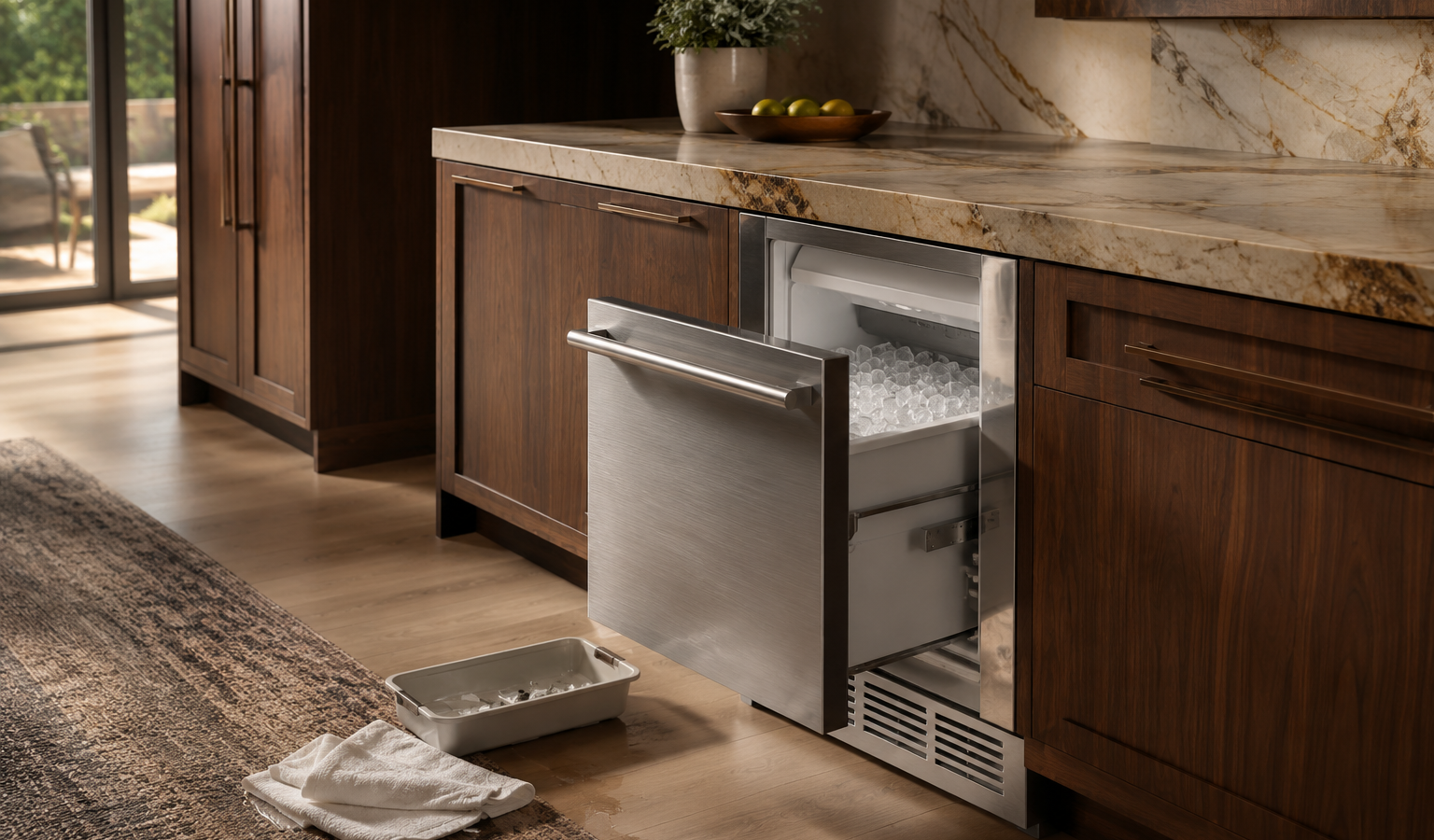
U-Line Drawer Refrigerator Not Cooling Properly
A refrigerated drawer can warm because the drawer is not sealing, airflow is blocked, the front ventilation path is restricted, the temperature sensor is seeing an abnormal condition, or the refrigeration system is not…

A U-Line drawer refrigerator that is warming is most often a closing, alignment, or airflow issue before it is a failed component. Check that each drawer shuts fully with nothing under the gasket, keep the front grille clear, and measure the temperature instead of judging by touch.
A refrigerated drawer can warm because the drawer is not sealing, airflow is blocked, the front ventilation path is restricted, the temperature sensor is seeing an abnormal condition, or the refrigeration system is not keeping up.
Start With the Operating Pattern
- Confirm each drawer closes fully and no container interferes with the gasket.
- Measure the drawer temperature instead of judging by touch.
- Keep the front grille and internal air paths clear.
Change one condition at a time. Resetting power, changing settings, cleaning several systems, and moving the unit all at once can erase useful evidence.
| Symptom | What it can point to | What you can safely check |
|---|---|---|
| Drawer feels warm but one drawer is stuck slightly open | Gasket not sealing or a container in the way | Remove anything touching the gasket and close the drawer firmly |
| Both drawers warm | Blocked grille, ambient heat, or a cooling fault | Clear the grille and measure the temperature |
| Display and lights on, no cooling | A display-only mode or a cooling fault | Read your model’s guide for a showroom setting |
| Drawer looks crooked or catches | Alignment disturbed by shipping or panel installation | Look from above to see if it appears square |
U-Line-Specific Context
U-Line products use compact, front-vented and undercounter-oriented refrigeration architecture. Exact model, installation type, water/drain configuration, and controller generation matter before technical information is applied. Ice machines add water level, drain, cleaning, refrigeration, pump/auger/harvest, and sensor stages that should be evaluated in sequence.
Why the Symptom Is Not the Diagnosis
A symptom identifies a system to investigate; it does not identify one replacement part. Installation ventilation, water/drain conditions, door or drawer sealing, sensors, fans, pumps, controls, compressor operation, and the sealed refrigeration system can create overlapping symptoms.
Can drawer misalignment look like a cooling fault?
The guide for one outdoor-designed U-Line drawer unit says its drawers are aligned at the factory but shipping or installing an overlay panel can disturb them. It describes checking three directions: side to side (square when viewed from above), front to back (not cocked), and top to bottom (level). A drawer that is out of line may not seal against its gasket.
That guide says adjustment requires unplugging the unit and disconnecting wiring for the top drawer, with minor fixes made at a slide mounting screw and severe ones requiring new slide holes. Leave that to service rather than loosening slides yourself.
When the Pattern Needs Professional Diagnosis
If temperature remains high, service may need to compare drawer and door sensing, thermistors, fans, controls, compressor operation, and refrigeration performance.
What if the display works but the drawer is warm?
Two U-Line guides, one for a refrigerator and one for a drawer unit, say a unit that has a working display and lights but will not cool should be checked for showroom mode, in which the compressor and fans do not run. The documented fix is to interrupt power momentarily. Check your manual for the exact step on your model.
The drawer guide also says a display temperature that differs from the set point means the unit is still moving toward it, and that the time depends on ambient conditions, product load, and door openings. A freshly stocked drawer can read warm for a while without being faulty.
What to Record Before Service
Write down the complete U-Line model number, product family, indoor/outdoor and panel-ready status, exact symptom, measured temperature where relevant, ice-production stage where relevant, water/drain behavior, and any E-code, Er-code, flashing LED, cleaning reminder, door message, or communication warning before reset.
Good observations reduce repeated owner checks and let the technician choose a focused test path. A cabinet that is warm after a large load, an ice machine that fills but does not harvest, and an ice machine that never receives water are three different diagnostic starting points.
Error-Code and Platform Context
Installation and Access Context
Leave undercounter, panel-ready, drawer, or outdoor U-Line products installed unless the service team specifically requests access. Moving a unit can disturb cabinetry, flooring, front-ventilation clearances, water lines, drains, or electrical connections.
For condos, high-rises, outdoor kitchens, and custom bars, include loading, elevator, shutoff, drainage, and clearance details when booking.
Common Mistakes to Avoid
Do not clear a useful code before recording it. Do not use a commercial-controller meaning for a residential appliance because the letters look the same. Do not treat a cleaning reminder or steady-status light as a hardware fault.
One controlled owner-level check is useful when it answers a question. Repeated resets, disassembly, or aggressive cleaning can remove evidence or create a second problem.
Drawer Refrigerator Questions
Why would a drawer refrigerator warm up if it is running?
The drawer may not be sealing, airflow may be restricted, or the unit may be in a display-only mode. Check the closing and the grille first, then measure the temperature.
Can I adjust a misaligned drawer myself?
Not safely. One guide says adjustment needs the unit unplugged and drawer wiring disconnected, so leave it to service.
How long should a drawer take to cool after loading?
It depends on ambient conditions, how much was loaded, and door openings. One guide says the display moves toward the set point over time, so wait before drawing conclusions.
Related U-Line Reading
- For adjacent symptoms, read U-Line Refrigerator Not Cooling: Separate Ventilation, Door Sealing, and the Cooling System and U-Line Beverage Center Not Cooling: Check Airflow, Loading, and Temperature Recovery.
Similar Articles
- U-Line Wine Refrigerator Not Cooling: One Zone, Both Zones, or the Whole Cabinet?
- U-Line Refrigerator Not Cooling: Separate Ventilation, Door Sealing, and the Cooling System
- U-Line Beverage Center Not Cooling: Check Airflow, Loading, and Temperature Recovery
- U-Line Wine Refrigerator Not Cooling: One Zone, Both Zones, or the Whole Cabinet?

Turn this guide into a clear on-site diagnosis
FAQ
Frequently asked questions
Use one normal model-approved restart when appropriate and record any code or message first. If the symptom returns, repeated resets are not a repair.
No. The technical source preserves model and control-platform applicability because the same raw code can differ by generation.
Do not perform live electrical, internal pump/control, or sealed-refrigeration work. Leave tightly fitted units installed unless safe access is planned.
U-Line has multiple residential generations, ice-machine architectures, dual-zone products, and separate commercial controllers. Exact model identity prevents the wrong diagnostic path.
Keep reading
More from the guides
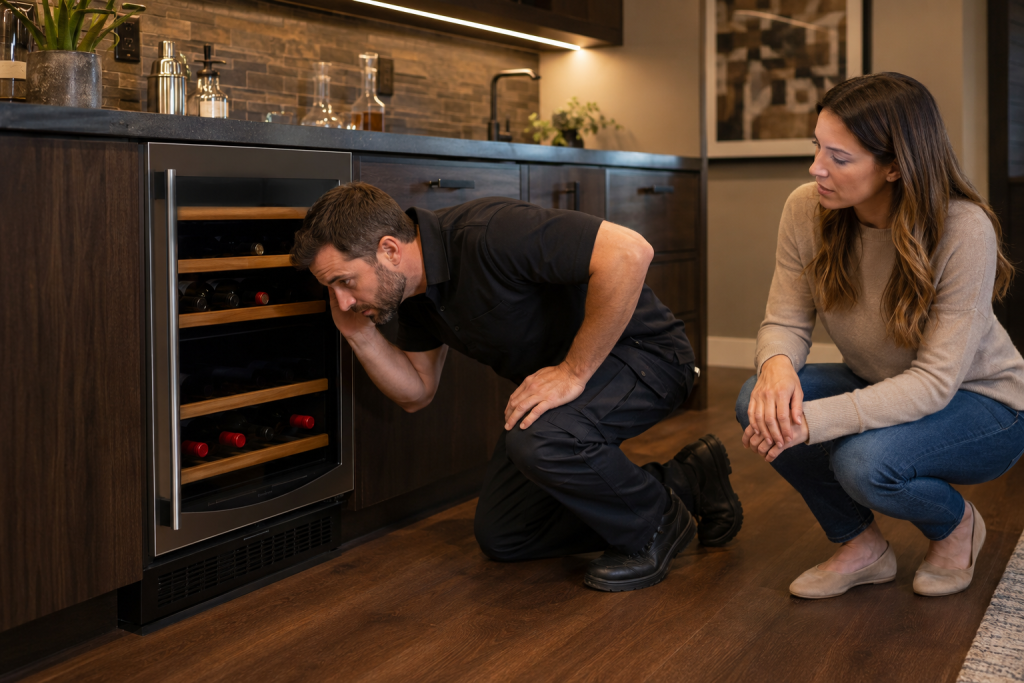
U-Line Wine Cooler Fan Running Constantly: When Long Runtime Is a Clue
A fan can run for long periods during normal recovery, but constant fan operation combined with unstable temperature, frost, unusual noise, or a warm cabinet may indicate an…
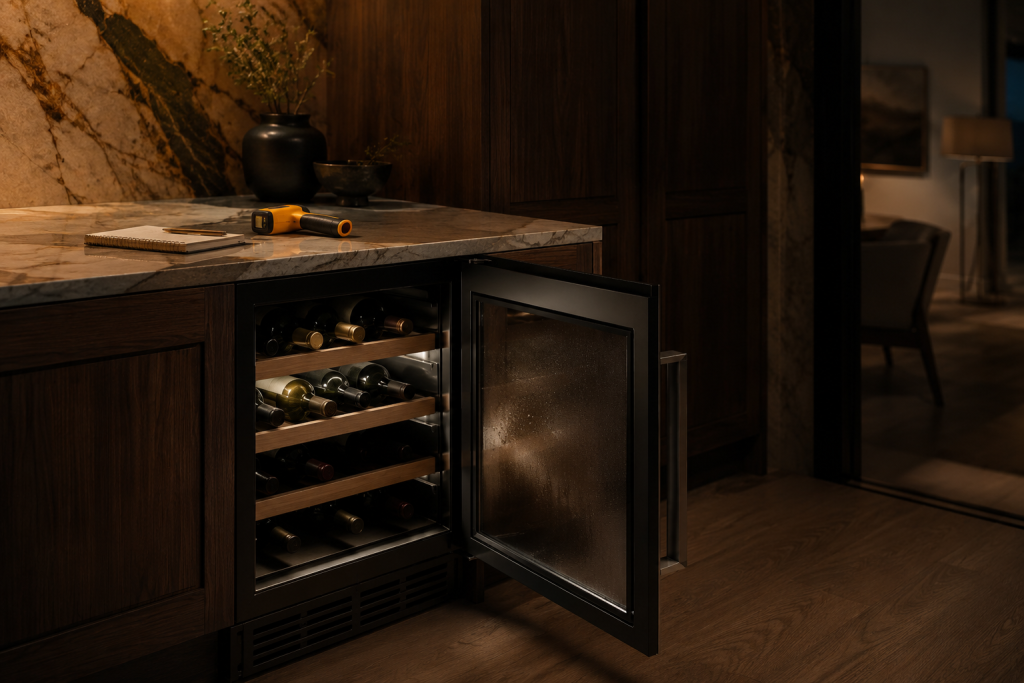
U-Line Outdoor Refrigerator Not Cooling in Hot Weather
Outdoor refrigeration works in a tougher environment than an indoor unit. High ambient temperature, direct sun, restricted front ventilation, a poor door seal, heavy loading, sensors, fans, controls,…
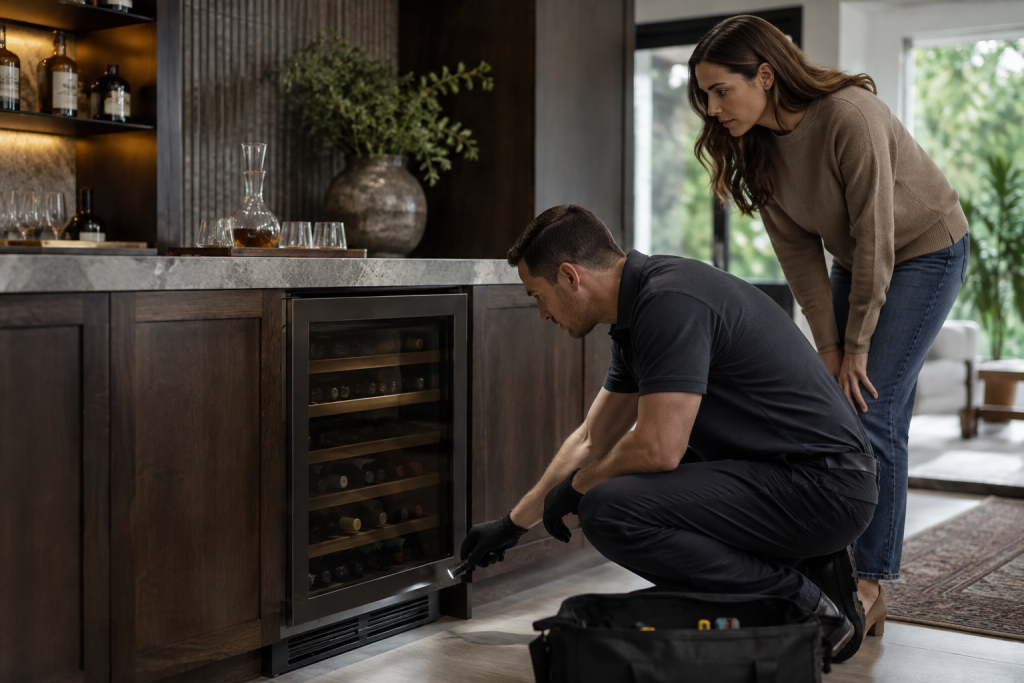
U-Line Wine Refrigerator Not Cooling: One Zone, Both Zones, or the Whole Cabinet?
A U-Line wine refrigerator should be evaluated as a temperature trend. On dual-zone products, whether one zone or both zones drift helps separate zone sensing and airflow from…
Turn this guide into a clear on-site diagnosis
Book a repair
Tell us what’s wrong — we’ll take it from there
Share a few details and we’ll confirm an appointment. Prefer to talk? Call us and we’ll help right away.
Phone
(844) 706-1091
Hours
Mon–Sat: 8:00 AM – 7:00 PM
Service area
Serving Miami, New York, Houston, Los Angeles and San Diego metro areas.
Response time
Response time varies by location and service availability.
Request your repair
Fill in the form below and we’ll confirm an appointment.