
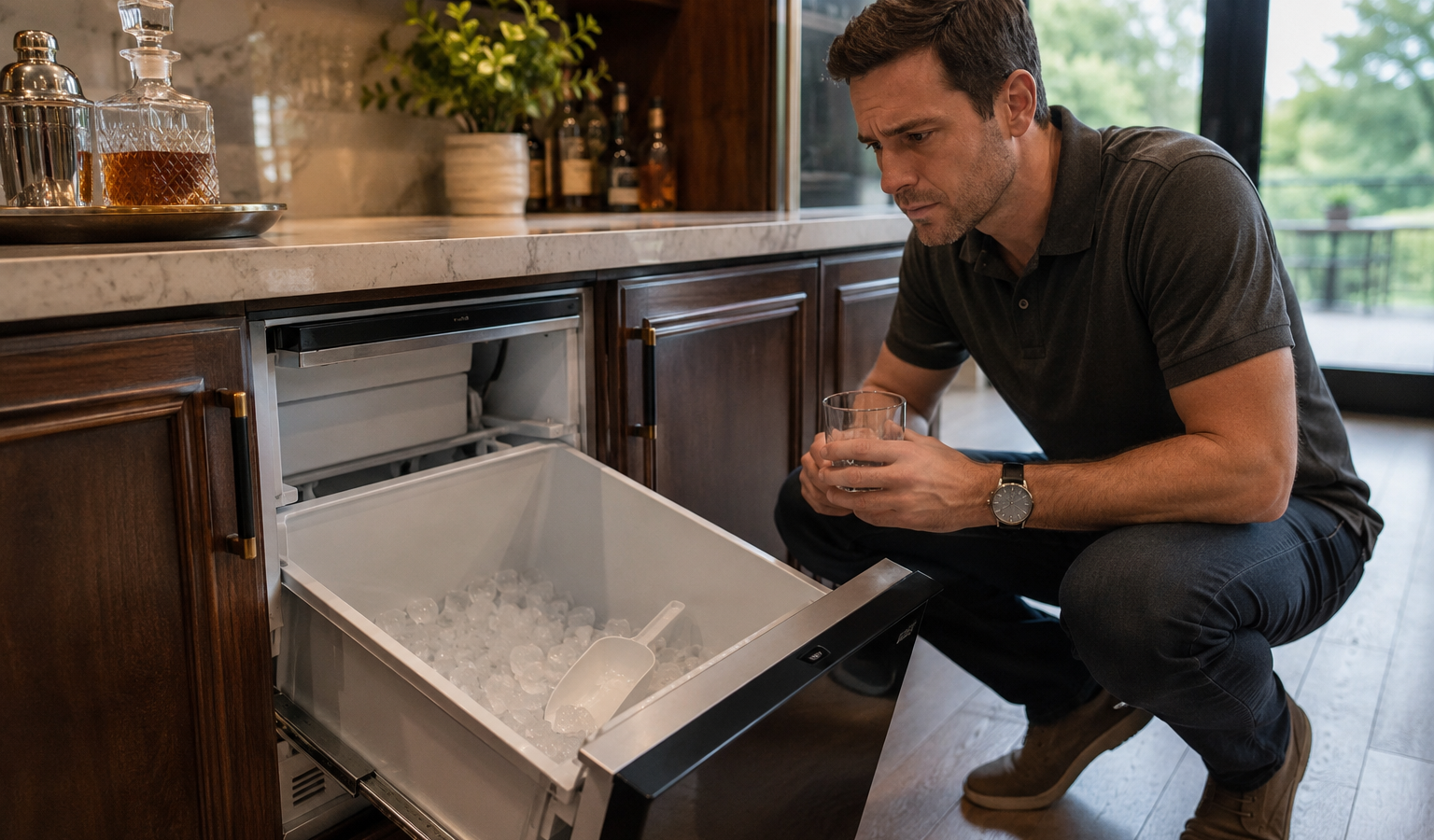
U-Line Ice Maker Making Too Little Ice: Production Rate, Water, Temperature, or Scale?
Low ice production is different from no ice. The machine may be filling and freezing but losing efficiency because of water conditions, cleaning or scale, temperature, ventilation, drainage, sensing, or mechanical wear.

When a U-Line ice maker makes less ice than it used to, check the simple conditions that reduce output before suspecting a part: a dirty condenser, a blocked front grille, a hot room, a paused mode, or cleaning that is overdue. If output stays low after those are ruled out, the evaporator, sensors, water supply or refrigeration system needs diagnosis.
Low ice production is different from no ice. The machine may be filling and freezing but losing efficiency because of water conditions, cleaning or scale, temperature, ventilation, drainage, sensing, or mechanical wear.
Step 1 — Confirm the Condition
Record how much ice is produced over a consistent period.
Step 2 — Compare a Related Stage or Function
Confirm normal water supply and model-appropriate cleaning status.
Step 3 — Make One Safe External Check
Keep front ventilation clear.
Can a warm room reduce how much ice a machine makes?
The guide for one U-Line clear ice model lists an ambient operating range and says that a warmer room can reduce ice production. The same guides tell you to keep units out of direct sunlight and away from heat-producing equipment, so a machine moved next to an oven or into a sunny spot can slow down with nothing wrong inside.
Modes matter too. On that clear ice guide, silent mode suspends ice production for a set period, and a nugget model’s guide describes a door alert that halts production when the door is left open. A machine in either state looks like it is underproducing when it is following its settings.
U-Line-Specific Context
U-Line products use compact, front-vented and undercounter-oriented refrigeration architecture. Exact model, installation type, water/drain configuration, and controller generation matter before technical information is applied. Ice machines add water level, drain, cleaning, refrigeration, pump/auger/harvest, and sensor stages that should be evaluated in sequence.
Low Output: What It Can Point To
| Symptom | What it can point to | What you can check |
|---|---|---|
| Output dropped in a warm room | High ambient temperature | Move heat sources away and check the guide’s operating range |
| Output dropped after the grille area got dusty | Dirty condenser | Clean the condenser per your guide with power disconnected |
| Little ice after silent mode was used | Production paused by the setting | Turn the mode off and check again later |
| Little ice and a clean reminder is showing | Cleaning or scale | Run the model’s cleaning cycle |
| Ice forms but will not release | Dirty evaporator, unit not level or a harvest valve fault | Check level; stop at diagnosis |
| Ice thick or thin from cycle to cycle | Water starvation or a dirty evaporator | Confirm the supply valve is open |
When Service Testing Makes Sense
If production stays low after normal conditions are confirmed, the refrigeration, water, sensor, pump, auger, harvest, or control system may need service.
Which dirty parts cut ice output?
The service tables for one U-Line clear ice model give three causes for low ice: a dirty condenser, a dirty evaporator, and a faulty bin thermistor, which is the temperature sensor that tells the machine the bin is full. A nugget model’s guide lists a dirty condenser and the same bin sensor for low ice as well.
The condenser is the part you can reach in a manual-documented way: the guide for one refrigerator says to clean it about every six months, with power disconnected, using a soft brush or vacuum and no cleaner. The evaporator and the sensor belong to service, so a machine that still underproduces after a clean condenser and a completed cleaning cycle is ready for a diagnosis.
Record the exact model and code or message before resetting. The same raw U-Line code can differ by generation or controller platform.
What to Record Before Service
Write down the complete U-Line model number, product family, indoor/outdoor and panel-ready status, exact symptom, measured temperature where relevant, ice-production stage where relevant, water/drain behavior, and any E-code, Er-code, flashing LED, cleaning reminder, door message, or communication warning before reset.
Good observations reduce repeated owner checks and let the technician choose a focused test path. A cabinet that is warm after a large load, an ice machine that fills but does not harvest, and an ice machine that never receives water are three different diagnostic starting points.
Installation and Access Context
Leave undercounter, panel-ready, drawer, or outdoor U-Line products installed unless the service team specifically requests access. Moving a unit can disturb cabinetry, flooring, front-ventilation clearances, water lines, drains, or electrical connections.
For condos, high-rises, outdoor kitchens, and custom bars, include loading, elevator, shutoff, drainage, and clearance details when booking.
Common Mistakes to Avoid
Do not clear a useful code before recording it. Do not use a commercial-controller meaning for a residential appliance because the letters look the same. Do not treat a cleaning reminder or steady-status light as a hardware fault.
One controlled owner-level check is useful when it answers a question. Repeated resets, disassembly, or aggressive cleaning can remove evidence or create a second problem.
Frequently Asked Questions
Can a hot room really reduce ice production?
Yes. The guide for one U-Line clear ice model says ambient temperatures above its stated range can reduce ice production and the ability to reach low temperatures. Keep the unit out of direct sun and away from heat sources.
How is low ice different from no ice?
Low ice means the machine fills, freezes and harvests but at a reduced rate, which points to efficiency issues like a dirty condenser or evaporator. No ice points to supply, level, pump or fill valve questions.
Will cleaning the condenser fix low ice?
It can help when dust is the cause, since a dirty condenser is cited for low ice in the guides. If output stays low afterward, the cleaning schedule, evaporator and sensors are the next things to evaluate.
Related U-Line Reading
- For adjacent symptoms, read U-Line Ice Machine Repair Cost: Water, Drain, Refrigeration, or Harvest? and Why Is My U-Line Ice Maker Leaking Water? Stop the Leak Before Repeating the Cycle.
Similar Articles
- U-Line Ice Machine Drain Blocked: When Standing Water Becomes a Stop-Use Condition
- U-Line Ice Machine Repair Cost: Water, Drain, Refrigeration, or Harvest?
- Why Is My U-Line Ice Maker Leaking Water? Stop the Leak Before Repeating the Cycle
- U-Line Ice Machine Drain Blocked: When Standing Water Becomes a Stop-Use Condition

Turn this guide into a clear on-site diagnosis
FAQ
Booking & service questions
Use one normal model-approved restart when appropriate and record any code or message first. If the symptom returns, repeated resets are not a repair.
No. The technical source preserves model and control-platform applicability because the same raw code can differ by generation.
Do not perform live electrical, internal pump/control, or sealed-refrigeration work. Leave tightly fitted units installed unless safe access is planned.
U-Line has multiple residential generations, ice-machine architectures, dual-zone products, and separate commercial controllers. Exact model identity prevents the wrong diagnostic path.
Keep reading
More from the guides
U-Line Nugget Ice Maker Not Producing Nugget Ice: Water, Drain, Auger, or Refrigeration?
Nugget ice production depends on water level, drainage, evaporator freezing, auger and extrusion hardware, sensors, and controls. U-Line verified RNP115 and URNP115 data also include specific Er-series diagnostics…
U-Line Clear Ice Machine Producing Cloudy Ice: Water Quality, Cleaning, or Circulation?
Cloudy ice can reflect water quality, scale, cleaning condition, circulation, or freeze and harvest performance. Visual quality is useful evidence but should be compared with production rate and…
Why Does My U-Line Ice Maker Make Strange Noises?
Clicks, pump sounds, water flow, fan noise, and harvest sounds can be normal at certain stages, while grinding, repeated stalled-motor noise, rattling, or new loud vibration may point…
Turn this guide into a clear on-site diagnosis
Book a repair
Tell us what’s wrong — we’ll take it from there
Share a few details and we’ll confirm an appointment. Prefer to talk? Call us and we’ll help right away.
Phone
(844) 706-1091
Hours
Mon–Sat: 8:00 AM – 7:00 PM
Service area
Serving Miami, New York, Houston, Los Angeles and San Diego metro areas.
Response time
Response time varies by location and service availability.
Request your repair
Fill in the form below and we’ll confirm an appointment.