
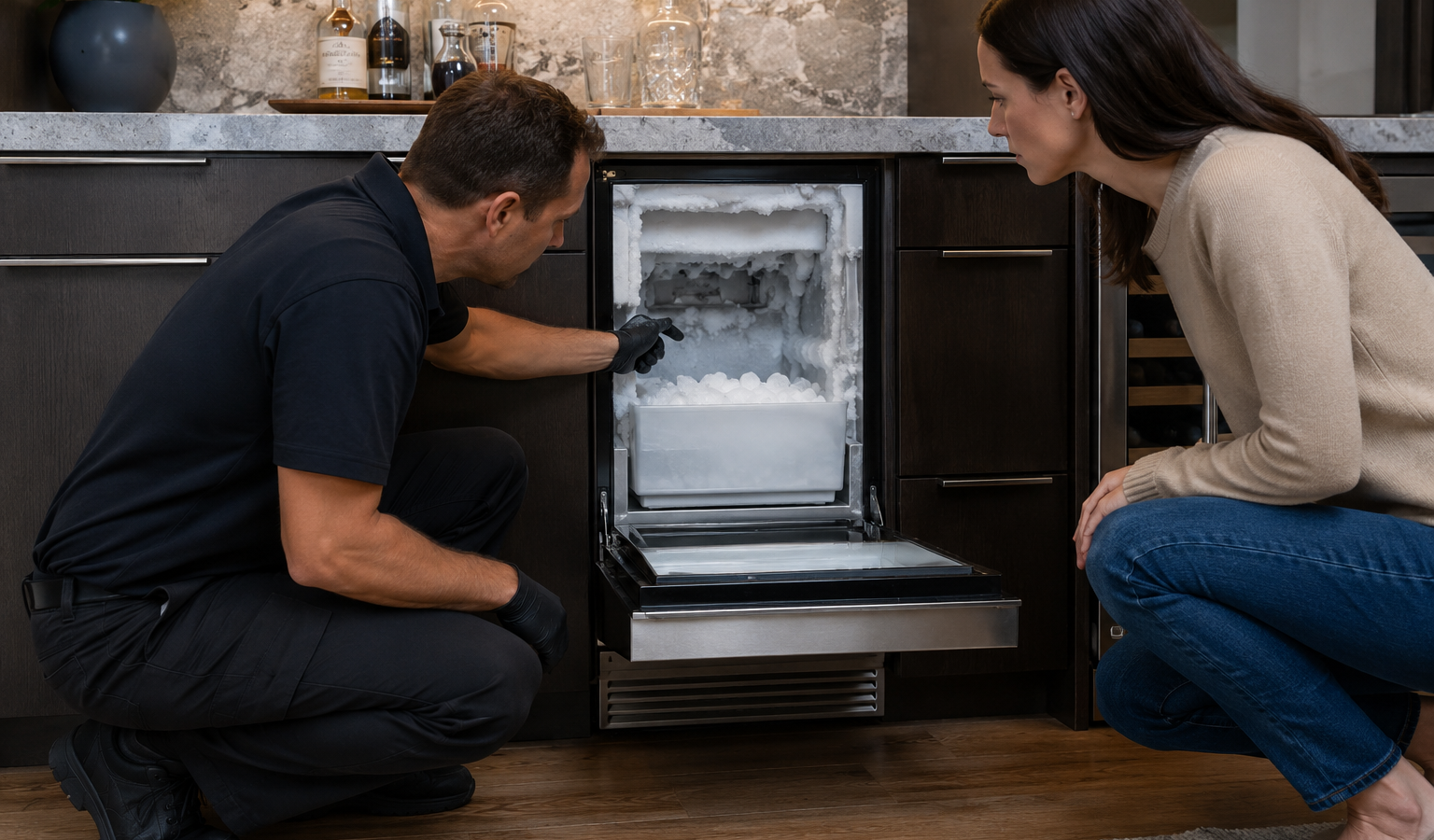
U-Line Ice Machine Drain Blocked: When Standing Water Becomes a Stop-Use Condition
A blocked drain can back water into the machine or cabinetry. U-Line technical records include drain-blocked and pump or drain conditions on applicable residential platforms, so repeated operation can worsen leakage.

If an ice machine has standing water in the bin or water backing up from the drain, stop the machine and check only the visible drain path. A restricted hose, a failed drain pump or a dump valve can each cause it, and running more cycles adds more water to the problem.
A blocked drain can back water into the machine or cabinetry. U-Line technical records include drain-blocked and pump or drain conditions on applicable residential platforms, so repeated operation can worsen leakage.
Safe External Checks
- Stop the machine if water is backing up or escaping.
- Check only the visible household drain path that is safe and owner-accessible.
- Do not reach into powered pump or control compartments.
U-Line-Specific Context
U-Line products use compact, front-vented and undercounter-oriented refrigeration architecture. Exact model, installation type, water/drain configuration, and controller generation matter before technical information is applied. Ice machines add water level, drain, cleaning, refrigeration, pump/auger/harvest, and sensor stages that should be evaluated in sequence.
Does an ice machine use a gravity drain or a drain pump?
The guide for one U-Line clear ice model says the drain cannot sit directly below the unit because the base is solid, and gives a gravity-drain rule of a downward slope along the run, with no traps and venting per code. Models with a factory drain pump are identified by the model number in that guide, and a pump is needed when the drain is a standpipe, a disposal, a spigot or any run that does not meet the gravity rules.
Which kind you have changes the diagnosis. A gravity drain failing is mostly a routing or kink problem, while a pump setup adds a motor and a sensor to the list.
Water in the Bin: What It Can Point To
| Symptom | What it can point to | What you can check |
|---|---|---|
| Water pooling in a bin | Restricted drain hose or debris | Look for a kinked or crushed visible hose |
| Pooling on a pump model | Failed drain pump or dump valve | Stop the machine; the pump is a service item |
| P1 on a nugget model | Restricted drain or failed pump (one guide); a missing power-harness jumper on a model without a pump | Note the code before any reset |
| Water at hose joints | Loose connection | Check visible joints with the unit off |
| Leak near the base with a water-level code | Leak sensor triggered | Do not clear it repeatedly; arrange diagnosis |
Safety Boundary
If drainage does not recover or water reaches electrical areas, keep the unit off and arrange diagnosis.
Stop normal operation for smoke, sparking, burning electrical odor, repeated breaker or GFCI trips, water contacting electrical connections, or uncontrolled warming that threatens food safety. Do not perform live electrical or sealed-refrigeration work as a homeowner.
Does a cleared drain prove the machine is fixed?
No. A straightened hose explains the water but does not prove the pump is healthy, so arrange a diagnosis if water returns.
A hose that was kinked and is now straight explains the water, but it does not prove the pump is healthy. If water returns after a correct run and no kinks, the pump or its valve is the next suspect. One U-Line guide notes that pump-equipped units continue removing water even in Sabbath mode, so a pump that runs by itself is not a sign of a malfunction.
On a nugget model, the leak sensor at the base can react to water reaching its probes. The guide describes drying both probes and cycling power as the reset, with a delay before it reactivates, and treats the leak itself as the thing to find.
What to Record Before Service
Write down the complete U-Line model number, product family, indoor/outdoor and panel-ready status, exact symptom, measured temperature where relevant, ice-production stage where relevant, water/drain behavior, and any E-code, Er-code, flashing LED, cleaning reminder, door message, or communication warning before reset.
Good observations reduce repeated owner checks and let the technician choose a focused test path. A cabinet that is warm after a large load, an ice machine that fills but does not harvest, and an ice machine that never receives water are three different diagnostic starting points.
Installation and Access Context
Leave undercounter, panel-ready, drawer, or outdoor U-Line products installed unless the service team specifically requests access. Moving a unit can disturb cabinetry, flooring, front-ventilation clearances, water lines, drains, or electrical connections.
For condos, high-rises, outdoor kitchens, and custom bars, include loading, elevator, shutoff, drainage, and clearance details when booking.
Common Mistakes to Avoid
Do not clear a useful code before recording it. Do not use a commercial-controller meaning for a residential appliance because the letters look the same. Do not treat a cleaning reminder or steady-status light as a hardware fault.
One controlled owner-level check is useful when it answers a question. Repeated resets, disassembly, or aggressive cleaning can remove evidence or create a second problem.
Frequently Asked Questions
Does a P1 code mean the drain pump has failed?
On the guides for one nugget model, P1 means the pump circuit is open, which can be a restricted drain or a failed pump. A model without a pump can show it when a power-harness jumper is missing.
Can I keep using the ice maker with water in the bin?
No. Standing water means the drain is not keeping up, so stop the machine until the cause is found.
Why is there water in my clear ice bin?
One U-Line clear ice guide ties it to a restricted drain, and recommends keeping the hose straight and free of kinks. Pump-equipped models add the pump as another possible cause.
Related U-Line Reading
- For adjacent symptoms, read U-Line Ice Machine Repair Cost: Water, Drain, Refrigeration, or Harvest? and Why Is My U-Line Ice Maker Leaking Water? Stop the Leak Before Repeating the Cycle.
Similar Articles
- How to Clean a U-Line Clear Ice Machine Without Skipping the Water System
- U-Line Ice Machine Repair Cost: Water, Drain, Refrigeration, or Harvest?
- Why Is My U-Line Ice Maker Leaking Water? Stop the Leak Before Repeating the Cycle
- How to Clean a U-Line Clear Ice Machine Without Skipping the Water System

Turn this guide into a clear on-site diagnosis
FAQ
Booking & service questions
Use one normal model-approved restart when appropriate and record any code or message first. If the symptom returns, repeated resets are not a repair.
No. The technical source preserves model and control-platform applicability because the same raw code can differ by generation.
Do not perform live electrical, internal pump/control, or sealed-refrigeration work. Leave tightly fitted units installed unless safe access is planned.
U-Line has multiple residential generations, ice-machine architectures, dual-zone products, and separate commercial controllers. Exact model identity prevents the wrong diagnostic path.
Keep reading
More from the guides
U-Line Outdoor Refrigerator Electrical Safety: Water, GFCI Trips, and Stop Conditions
Outdoor-rated refrigeration still depends on a safe electrical installation. Standing water, repeated GFCI or breaker trips, damaged connections, or electrical odor require more caution than a normal cooling…
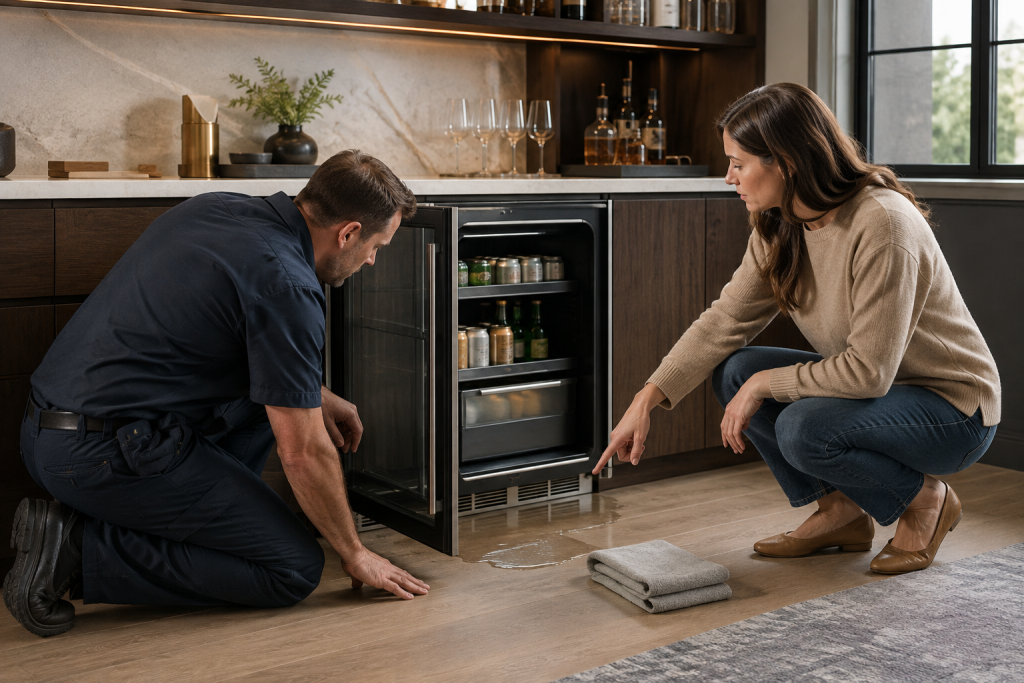
U-Line Refrigerator Compressor Problems: Warning Signs and the Safety Boundary
A refrigerator that clicks, becomes unusually hot, trips a breaker, or cannot cool may have a compressor or start-system problem or another refrigeration or electrical fault. Owner diagnosis…
U-Line Refrigerator Warming Up: Protect Food Before Parts Diagnosis
When a refrigerator or refrigerator-freezer combination cannot maintain temperature, food safety becomes the first decision. Protect perishables before spending time on code interpretation.
Turn this guide into a clear on-site diagnosis
Book a repair
Tell us what’s wrong — we’ll take it from there
Share a few details and we’ll confirm an appointment. Prefer to talk? Call us and we’ll help right away.
Phone
(844) 706-1091
Hours
Mon–Sat: 8:00 AM – 7:00 PM
Service area
Serving Miami, New York, Houston, Los Angeles and San Diego metro areas.
Response time
Response time varies by location and service availability.
Request your repair
Fill in the form below and we’ll confirm an appointment.